

The Scottish novelist Peter May wrote, “the purpose of research is to inform you, the writer. So that when you come to write, you do so from a position of knowledge… [and so] your reader can trust that you know what you’re writing about.” I’ve written a historical mystery series set in the 1910s featuring a forty-ish woman named Alafair Tucker, who lives with her husband, Shaw, and their ten children on a prosperous horse farm outside of Boynton, Oklahoma. Being as I have no children, have never lived on a farm, never cooked on a wood stove, washed in a iron tub, or sewed on a treadle sewing machine, much less shoed a horse, I do tremendous amounts of research so that I’ll know what I’m talking about.
But only a very small percent of the research I do for each book finds its way onto the page. I’m not writing a history book, I’m trying to create a world, and it’s amazing how little it takes to add just that perfect touch of authenticity to your story.
For each book I write, I keep a notebook and file full of information that I read up on as I need it. Much of my research may not be used, for as a book advances some of the ideas I started out with fall by the wayside. Even so, when the book is finally done I will have added quite a bit to the huge amount of arcane knowledge rattling around in my head.
Why, then, do I spend so much time learning everything I can about the times, lives, and mores of my characters when I know I’m not going to write about most of it? Because my own familiarity with the era I’m writing about is going to show without my having to make a big deal of it. The characters are going to move naturally through their world without thinking about it, just like we do in our own world.
Alafair ponders a problem while scraping the ashes from the fire box in her kitchen stove before breakfast. She doesn’t think about the history, configuration, or general use of the cast-iron, wood burning stove in rural Oklahoma in 1915. But I do. It isn’t a bit important to the story that the reader knows any of those things either. All she needs to know, or cares about, is that Alafair ponders a problem while scraping the ashes from the fire box. One single sentence in the book represents an hour of research and quite an education in cast iron cook stoves for me that may or may not ever be used again. Yet, isn’t that a picture? One tiny detail triggers a mental image and puts the reader in a country kitchen early one morning in 1915.
It’s a tightrope. An author wants to create as authentic a world as she can, but the whole point is to engage and involve your reader in your story, not to write a history book. A novelist should strive to be just accurate enough not to alert the anachronism police.
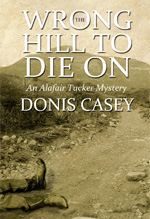
The sixth book in the Alafair Tucker series,The Wrong Hill to Die On, (Nov. 2012) is set in Arizona, where I live, rather than in Oklahoma, where Alafair lives. So here are the problems I have to solve before I even begin: 1. Why on earth would Alafair go to Arizona in the first place? 2. Once she gets there, what is going on that she could get herself involved in, how, and why? So in order to start to construct my story, I began with a trip to my nearest university library where I read through every issue on microfilm of the Arizona Republican newspaper for late February and early March of 1916, and thanks to interlibrary loan, I did the same for the Muskogee (Oklahoma) Phoenix.
I discovered that in Oklahoma, the end of 1915 and the beginning of 1916 were some of the rainiest months in years, accompanied by severe flooding. Therefore, there was lots of flu and bronchitis going around – enough that it was mentioned in the newspapers. Handily, in the late 1800s through the mid-1900s, Arizona was known as a place where people with chronic lung problems came to let the dry air cure them. Problem number one, solved!
And problem number two? There was a revolution going on in Mexico at the time, as well as the war in Europe. The Mexican Revolution interested the Germans no end, and there were lots of German “military advisers” in Mexico. Even better, in the first three months of 1916, residents of the entire Southwestern U.S. were hysterical over the possibility of a cross-border invasion from Mexico by the Revolutionary Army of Pancho Villa. In fact – and now that almost 100 years have passed, I can be happy about it – in March 1916, the Villistas did exactly that, increasing the hysteria in Arizona to a fever pitch.
For icing on the cake, during the winter of 1915-1916, a major (silent) motion picture, The Yaqui, was being shot in Tempe, the very town in which I set my novel.
Anyone who can’t make a story out of all that should have her authorly epaulets ripped off.
More Places to Go
Donis on Facebook
Type M for Murder